
Our Services Include
At Semantica Digital, we design and develop custom AI automation systems that integrate with your existing tools and processes. We work across multiple AI platforms and large language models to find the right fit for each use case, rather than locking you into a single vendor.

Workflow
AI workflow automation

Agents
AI agents for business process automation

Chatbots
AI chatbots for customer engagement

Assistants
Custom conversational AI assistants.

Automation
AI content automation and publishing pipelines

Reduce manual work, and unlock new levels of productivity
AI Agents
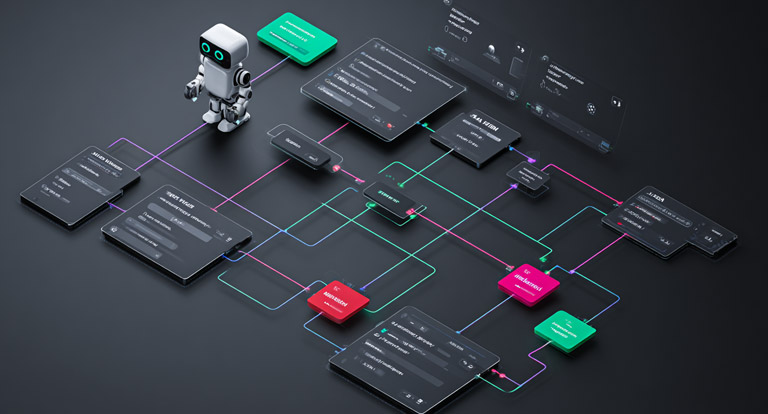
AI agents are intelligent software systems designed to perform tasks autonomously and interact with business software. Unlike basic automation tools or simple chatbots, AI agents can analyse data, make decisions, interact with APIs, and complete complex multi-step processes without human intervention at each stage.
A custom AI agent is developed specifically for your organisation’s workflows and systems. These agents operate within defined boundaries but have the autonomy to reason through problems, select the right tools, and adapt their approach based on the situation.
Consider the difference: a chatbot might answer a guest’s question about room availability. An AI agent checks your booking system, applies your pricing rules, creates the reservation, sends the confirmation email, and updates your CRM, all in a single interaction.

Key Capabilities of AI Agents
- Task-oriented automation: AI agents execute specific workflows and operational tasks within your business environment, handling multi-step processes end to end.
- Integration with business systems: AI agents connect with APIs, databases, CRM platforms, booking systems, payment gateways, and internal software tools.
- Autonomous decision-making: AI agents analyse information and take actions within predefined boundaries, escalating to humans when confidence is low or the situation requires it.
- Adaptive learning: Over time, AI agents improve performance by learning from interactions and operational data.

AI Chatbots
AI chatbots allow businesses to provide instant customer support and assistance 24 hours a day. Modern AI chatbots use natural language processing to understand user intent and respond conversationally, going far beyond the rigid decision trees of traditional chatbots.
AI chatbots can be integrated into websites, messaging platforms (including WhatsApp), and mobile applications to improve customer engagement and reduce support workloads.
Common AI chatbot use cases include:
-
Customer support automation
-
Product and service recommendations
-
Lead generation and qualification
-
Website customer assistance
-
Frequently asked questions automation
-
Appointment and booking assistance
AI Content Automation
AI-powered content automation helps businesses produce content faster while maintaining brand consistency. These systems go beyond simple text generation. They can ingest data, apply editorial rules, and publish across multiple channels automatically.
AI content automation integrates with your existing marketing workflows and CMS platforms to support end-to-end content creation and publishing.
Applications include:
-
Blog and article generation from structured data
-
eCommerce product descriptions at scale
-
Social media content creation and scheduling
-
Marketing copywriting and A/B variant generation
-
Email marketing campaigns
-
Internal documentation and reporting
Custom AI Assistants
Custom AI assistants are specialised conversational AI systems built using advanced large language models. Unlike off-the-shelf tools, these assistants are trained on your specific knowledge base, documents, and processes, and they respond in your brand voice.
We build custom AI assistants across multiple LLM platforms (including OpenAI, Anthropic, and open-source models) to ensure the best fit for your use case, budget, and data privacy requirements.
Custom AI assistant solutions can assist with:
-
Answering customer questions using your product and service data
-
Providing technical support based on internal documentation
-
Generating marketing content in your brand voice
-
Supporting internal teams with knowledge retrieval and onboarding
-
Assisting customers with product selection and recommendations
Key Features of Custom AI Assistants
-
Custom knowledge base: Your AI assistant references internal documents, product data, and company knowledge to provide accurate, contextual answers.
-
Brand voice configuration: Responses are customised to match your organisation’s tone, messaging, and communication style.
-
Multi-platform integration: Custom AI assistants integrate into websites, applications, WhatsApp, and internal tools through APIs.
-
Model flexibility: We select and benchmark the right language model for your needs, whether that is a cloud-hosted API or a locally deployed open-source model.
Data Privacy, Security & POPIA Compliance
Data privacy and compliance are not optional. When you deploy AI systems that process customer data, employee information, or sensitive business records, you need confidence that the technology meets local regulatory requirements.
At Semantica, we design AI solutions with data sovereignty and POPIA compliance in mind:
-
We can deploy AI models on local or private infrastructure, so your data does not have to leave South Africa or flow through international cloud APIs.
-
Where cloud-based AI services are appropriate, we advise on data processing agreements, encryption, and access controls.
-
All AI systems include configurable data retention policies and audit logging.
-
We implement role-based access controls so that sensitive data is only available to authorised users and systems.
-
Human-in-the-loop safeguards can be built in for high-stakes decisions, ensuring AI acts within defined boundaries.
AI adoption should not come at the cost of compliance. We help you get the benefits of automation while meeting your legal and ethical obligations.
Why Choose Semantica for AI Development
Semantica combines software development expertise, digital strategy, and automation engineering to build AI solutions that deliver measurable results.
What sets us apart:
-
Practical AI implementations designed around real business problems, not technology for its own sake.
-
Deep integration with your existing digital systems, platforms, and data sources.
-
Model-agnostic approach: we work across OpenAI, Anthropic, open-source models, and locally hosted LLMs to find the right fit.
-
Scalable, secure architecture with POPIA compliance built in.
-
Ongoing monitoring, optimisation, and support, because AI systems need continuous attention.
-
A proven track record building AI-powered automation systems for South African businesses across hospitality, eCommerce, fintech, and professional services.
What We Have Built
We are not just talking about AI. We are building it. Here are examples of the types of intelligent systems we develop:
-
Intelligence platforms that ingest live market data, classify and deduplicate information, and generate analyst-grade articles automatically.
-
AI-powered hospitality systems including direct booking engines, AI concierge modules, and revenue intelligence dashboards.
-
Automated content pipelines that transform a single piece of content into multiple platform-specific outputs for social media, email, and web publishing.
-
Custom WordPress integrations with AI-driven product discovery, dynamic content generation, and intelligent search.
Our AI Development Process
Implementing AI successfully requires more than deploying off-the-shelf tools. At Semantica, we follow a structured approach grounded in real engineering to ensure AI solutions deliver measurable business value.
1
Discovery & Opportunity Analysis
We analyse your workflows, systems, and operational processes to identify where AI can deliver the most impact. This includes auditing your existing data sources, APIs, and integration points.
2
Solution Architecture
Our team designs the technical architecture for your AI solution, covering model selection and benchmarking, prompt engineering, retrieval-augmented generation (RAG) design where applicable, API integration mapping, and data flow architecture. Solutions are designed with security, scalability, and POPIA compliance built in from the start.
3
Development & Integration
We build and integrate AI systems with your existing platforms, APIs, and software tools. This includes developing custom connectors, testing model outputs for accuracy and hallucination, and implementing human-in-the-loop safeguards where appropriate.
4
Testing & Quality Assurance
AI systems are tested against real-world scenarios to ensure reliability, accuracy, and performance. We benchmark outputs, stress-test integrations, and validate that the system handles edge cases gracefully.
5
Deployment, Monitoring & Ongoing Improvement
After launch, we monitor system performance, track output quality, and continue to optimise the system based on usage data and evolving business needs. AI is not a set-and-forget technology, and we treat it accordingly.
Frequently Asked Questions

AI automation uses artificial intelligence to automate tasks, workflows, and decision-making processes within a business. Unlike traditional rule-based automation, AI systems can analyse data, recognise patterns, and adapt over time to improve performance. Businesses use AI automation to streamline operations, reduce manual work, and increase efficiency across departments including marketing, customer service, finance, and operations.
AI chatbots are primarily designed for conversation and customer interaction. They help users find information, answer questions, or receive support. AI agents go further by performing actions and completing workflows. They can interact with multiple systems, automate tasks, and make decisions within defined parameters. For example, a chatbot may answer a customer question, while an AI agent could process a request, update a CRM system, and trigger a follow-up workflow automatically.

Yes. Most AI automation solutions are designed to integrate with existing software platforms and digital tools. AI systems can connect with CRM platforms, marketing software, databases, APIs, accounting systems, eCommerce platforms, and other operational tools. This allows businesses to automate workflows without replacing their current technology stack.
AI automation is increasingly accessible to businesses of all sizes. Small and medium businesses can benefit from automating repetitive tasks, improving customer support, and streamlining internal workflows. Modern AI solutions can be scaled to suit the size, budget, and operational needs of your organisation.
We design all AI solutions with data privacy as a core requirement. This includes options for local or private infrastructure deployment, configurable data retention policies, encryption, access controls, and audit logging. Where cloud-based AI services are used, we ensure appropriate data processing agreements are in place. Our goal is to deliver the benefits of AI while meeting South African regulatory obligations.
No AI system is perfect, which is why we build safeguards into every solution. Depending on the use case, this can include human-in-the-loop review for high-stakes decisions, confidence thresholds that trigger escalation, output monitoring and quality tracking, and rollback mechanisms. We also provide ongoing monitoring and optimisation so that issues are identified and addressed quickly.
The development timeline depends on the complexity of the project. Simple AI chatbot implementations may take a few weeks, while advanced AI agents or fully integrated automation systems may require several months of development. A typical project involves discovery, architecture design, development, integration, testing, and deployment.
We take a model-agnostic approach. Depending on your requirements, we work with OpenAI, Anthropic (Claude), Google (Gemini), open-source models (such as Llama and Mistral), and locally hosted LLMs. This flexibility means we can recommend the best model for your use case based on performance, cost, data privacy needs, and scalability.